That’s not a nugget… this is a nugget!
With apologies to “Crocodile” Dundee for the headline of this article, it’s no secret that central Victoria’s Golden Triangle has long been a Mecca for those seeking a big nugget or patch of gold. With its long history of being a constant nugget producing area, it’s not hard to see why so many flock to it year after year in search of coins, relics and that oh so precious yellow stuff.
Read through any of the old journals or records from the past and they reveal almost unbelievable finds. Who hasn’t heard of the legendary “Welcome Stranger” nugget of Moliagul that came in at a whopping 2,284 ounces or the “Welcome” nugget from Ballarat weighing an estimated 2,195 ounces. Just the thought of finding something even one-tenth their size is the stuff that dreams are made of and enough to get the pulse racing in any prospector. But it wasn’t just the big ones that forever etched the visions of instant wealth in the minds of those smitten with gold fever. Some incredible yields were won from ridiculously small claims; finds such as those made on the famous Castlemaine field where thousands of ounces from mere 8x8-yard claims were common, where the wash was “studded with nuggets like plums in a pudding.” Or the Potato Diggings at Kingower where the nuggets were so large and plentiful the diggers merely broke up the earth and bounced it up and down on their shovels listening for that tell-tale sound of metal striking metal, alerting them of a find. It’s interesting to note something written by E. J. Dunn in 1912 concerning the finding of large nuggets: “There is a tragic side to nuggets also, for in the early days the sudden acquisition of more or less wealth in the form of a nugget often caused the mind of the finder to become unhinged. Crimes were also committed to obtain possession of nuggets.” I must admit there is some truth to the first part of his statement as I’ve witnessed the so called “unhinging” a couple of times with the finding of big gold but I guess that’s been the curse of all sudden wealth and just typical of the human condition.
CONSIDERED TO BE NUGGETS
Another interesting thing about the early days was what the diggers considered to be nuggets. These days you often read about (and I’m guilty of this myself) 0.4, 0.8, 1-gram, 3-gram and so on bits of gold being referred to as “nuggets”. I knew an old miner who worked some deep lead mines as well as spending time on the famous Loddon River dredge, who would have referred to these “nuggets” as merely specks or colours. In fact, another old timer I knew who worked one of the last hydraulic sluicing claims on the Castlemaine field with his father many years ago, laughed at the word “nugget” being applied to such small bits of gold. I still remember talking to him about the claim and him telling me how they would have liked to have done more but were stopped. I asked him if they ever found good nuggets on it to which he replied “No”. I was shocked to hear that on a whole hillside known for coarse gold that they didn’t get any nuggets and when pressing further as to why: he simply said, “No, no nuggets but plenty of good colours up to a couple of ounces.” This guy simply did not consider anything under 10 ounces qualified as a nugget. Oh yeah, this was just after I’d shown him a 7-gram “nugget” I’d found the day before. But take heart, there are worse examples elsewhere in the world. In the USA they call anything remotely visible a nugget. Something that weighs just one-twentieth of a gram being called a “nugget” just doesn’t sound right does it, although they use pennyweights and grains rather than grams when they refer to the weight of tiny bits of yellow, which I’ll concede is more correct. But back to what the old guys did or did not call “nuggets”. It makes you wonder doesn’t it, just how many places aren’t on the list of nugget producing fields that may still have plenty of detectable gold up to a couple of ounces in size, remembering that most of the old timers would have referred to such lumps as being nothing more than “good colours”.
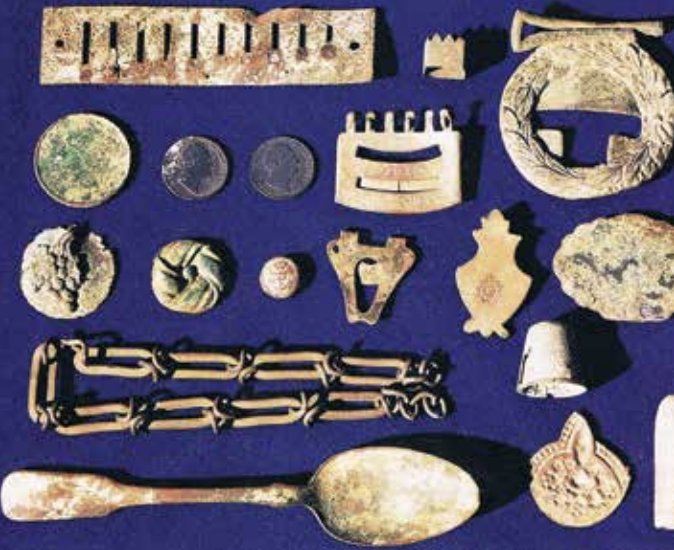
Relics and coins found in the Dunolly area of the Golden Triangle
REMAIN UNIDENTIFIED
I know of one such place, which will remain unidentified in this article, where this is the case. I had read about it a number of times and all that was mentioned was that fine gold up to matchhead size had been found there. Well, I can confirm nuggets up to four ounces being detected there as well as a house-brick size specimen with veins of gold running all through it. Which leads me to my wild card advice. I’ve lost count of how may good nuggets and patches have come out of ground that looks more suited to potato farming than nugget hunting. It pays to now and then have a go at what might appear to be “not the right ground”. I remember one place where I detected gold in ground that honestly resembled the dirt I grow my vegetables in at home, and now and then having to separate the gold from the tangle of grass roots it was encased in. I still shake my head when I recall that day. It hammers home that old saying about gold being where you find it. It’s very easy to become blinkered in your detecting style if you’re not careful. All it takes are a few good finds in a particular type of situation to lead a person into the habit of only detecting that type of ground. It’s a bad habit to get into and one that I have been guilty of falling into myself. These days the gold is getting harder to find regardless of how glowing the reports are. You constantly hear of those blokes that always seem to be finding good nuggets and patches but be aware that they are at the top of the food chain as far as gold prospecting goes and spend a lot of time in the field to get the results they do. They live, eat and breathe detecting and the average weekend fossicker shouldn’t get too disheartened when similar results are not achieved. But good gold is still out there and sometimes it can be just a matter of your lucky number coming up. We’ve all heard about the absolute novice camping on the most flogged ground for miles around only to lob onto a thumper that not only pays for his trip but his 4WD and caravan as well. It’s enough to make you cry at times after you’ve spent three weeks solid on the same ground. But such is the nature of gold and it always has been.

In fact, the “Herron” nugget that was found in Fryerstown in 1855 was discovered by “new chums” who decided to work an abandoned claim and came across the nugget merely inches from where the original claim holders left off. It even had a pick mark in it, possibly the last blow made by the previous owners. The “Herron” weighed an impressive 1,008 ounces net. Now a few words of warning with regards to handling gold. It’s quite a common practice among some prospectors upon finding a piece of gold, to place it inside their mouths to clean it. My advice is to never do this. Not only is it unhygienic but it is also potentially dangerous. I have both heard of and seen some terrible sicknesses occur from this practice. One person I know was ill for more than a year after contracting a virus that attacked his digestive system causing all sorts of complications. I have also seen huge infected cold sores result from merely holding a piece of gold between the lips. Let’s face it, who wouldn’t correct a small child caught placing dirt and stones inside their mouths and tell them how dirty it was to do so? And a final word about detectors. A dedicated gold detector with minimal discrimination abilities will be of little use if you only get away once or twice a year but spend every second weekend on the beach. The same could be said for a coin machine used for primarily hunting nuggets. Most reputable dealers will see you right giving demonstrations of each machine and its abilities. Some even go so far as to give field demonstrations which are at least worth a look but be advised that it’s not hard to pick a patch of ground where a bad machine can be made to look good and vice versa. Also be wary of people who run down one machine in order to push another. It’s not only unethical but also unfair to you as a customer as the machine being run down could be just what you’re after. And whenever you get disheartened and the signals just don’t seem to be coming, remember what the old timers said: “Gold, poor one day rich the next, all on the turn of a shovel.”